A multi-country eSIM is a single downloadable data plan that works in several countries, so you install it once and keep your phone online as you cross borders. There is no new QR code at each stop and no physical SIM to swap. It suits any trip with two or more destinations, and it is usually the simplest alternative to paying your home carrier’s roaming rates. Below we explain how these plans work, how to choose between regional and global coverage, what to set on your phone, and where the common traps are.
Roameogo
Stay Connected Across Borders
RoameoGo offers travel eSIM plans in 190+ destinations, with reusable eSIMs you can top up for future trips.
Explore global eSIM plans
At a glance
- A multi-country (regional or global) eSIM connects to partner networks in each country you visit, switching automatically at each border without a new installation.
- For a trip to one country only, a dedicated local eSIM is often the cheaper choice. Multi-country plans earn their place on trips with two or more stops.
- Most travel eSIMs are data only. You get no phone number, so calls and texts run through apps such as WhatsApp, and SMS codes go to your home line unless your plan includes a number.
- Turn on data roaming for the travel eSIM line only, and keep your home line’s data roaming off, to avoid surprise charges.
- Our Global Travel eSIM starts at £7.99 for 1 GB, and it is reusable: you can top it up for the next trip without reinstalling.
Table of Contents
What a multi-country eSIM actually is
A regular travel eSIM is tied to one country. You buy it for Spain or Japan, and it uses a local partner network there. A multi-country eSIM bundles agreements with partner networks in many places into one profile. When you land in a new country, your phone attaches to a partner network there and your data keeps flowing.
There are two broad types:
- Regional eSIMs cover a defined area, such as Europe, parts of Asia or North America. They fit a road trip, a rail pass or a multi-city itinerary in one part of the world.
- Global eSIMs cover a long list of countries across continents. They suit trips that jump between regions, or travelers who do not know yet where the next trip goes.
If you are new to the technology itself, our explainer on what an eSIM is and how it works covers the basics in a few minutes.
Why are people switching? In 2024 GSMA Intelligence research, 51% of eSIM users had used their eSIM for leisure or personal travel abroad in the previous 12 months. GSMA also describes travel eSIMs as moving the roaming market away from expensive carrier roaming toward digital-first providers with clearer pricing.
When one multi-country plan beats several local ones
The honest answer depends on your route. Here is how we think about it.
| Your trip |
Usually the better fit |
Why |
| One country, one week |
Single-country eSIM |
Dedicated local plans are often more cost-effective for a single destination |
| Three European cities in ten days |
Regional Europe plan |
One install, no border admin |
| Europe, then Asia, then home |
Global plan |
One profile instead of three |
| Frequent trips to different places |
Global, reusable plan |
Top up instead of installing again |
| Long stay in one country |
Local plan or local carrier |
Better data allowance per pound or dollar |
Two factors matter more than the headline price.
Count your borders, not your days. Every extra country on a single-country plan means another purchase, another installation and another moment of being offline on arrival. A multi-country plan removes all of that.
Estimate your data honestly. Maps, messaging and email use little. Video calls, streaming and hotspot sharing use a lot. Plans come in fixed allowances, so buy a size that covers your heaviest likely week rather than your lightest.
If you are heading abroad for a semester rather than a holiday, connectivity is one line in a bigger budget. A guide to student study abroad costs helps you see where a data plan sits next to rent, food and transport, and whether a regional plan or a local one suits a long stay.
Our plans for multi-country trips
Here are the plans we publish, with prices as listed on our site. All are one-off payments, not subscriptions.
A few notes on choosing:
- Global Travel eSIM is the one to look at first if your route crosses regions or changes often. The five sizes let you match the allowance to the trip.
- Premium Europe eSIM is different from the usual data-only plan. It includes calls, SMS and data, with a dedicated number, which solves the common problem of needing a number you can be reached on while abroad.
- North America and Data Only US are for trips focused on that region. Check the plan page for the exact coverage before you buy, since it is the final word on which countries are included.
Before buying any of them, make sure your phone supports eSIM. Our guide to checking eSIM phone compatibility takes about a minute, and it is worth doing at home, not at the airport.
Perspective: what we see travelers get wrong
We talk to travelers every day through WhatsApp support, and the same few things come up. The plan itself is rarely the problem. The setup and the expectations are.
First, people buy a plan sized for one country, then add a second country on the way and end up buying again. If your itinerary is even slightly uncertain, a multi-country plan costs less in effort than guessing right.
Second, people forget that most eSIM plans are data only. They arrive, assume their usual number works, and then miss a bank code or a call from a hotel. That is why we built the Premium Europe plan with calls, SMS and a dedicated number, and why we always tell travelers to decide in advance how they will receive verification texts.
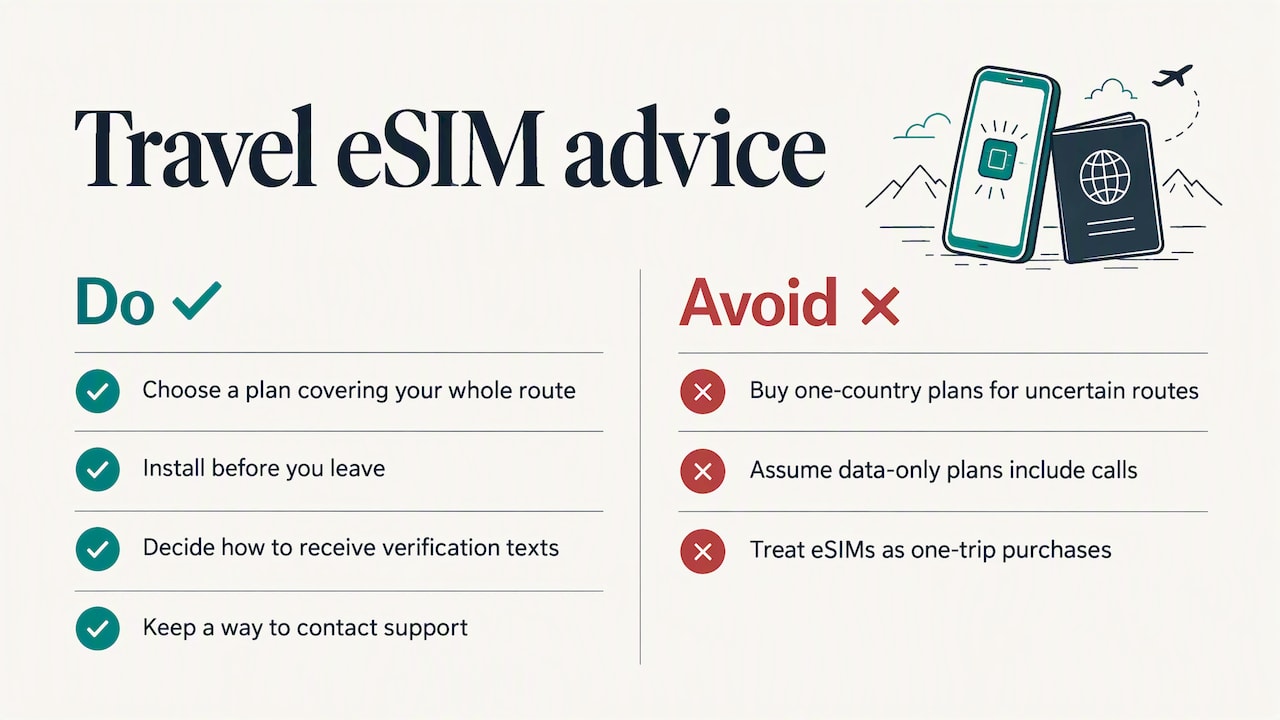
Third, people treat an eSIM as a one-trip purchase. We designed ours to be reusable. When the next trip comes, you top up the same eSIM instead of scanning a new code, and our one eSIM top-ups page explains how.
Our advice: pick the simplest plan that covers your whole route, install it before you leave, and keep a way to reach us if something goes wrong. A real person on WhatsApp is worth more than a long FAQ when you are standing in a station with no signal.
— Kieron
Set up your phone before you fly
Most trouble with multi-country eSIMs is a setting, not a fault. Follow these steps at home on Wi-Fi.
- Confirm your phone is eSIM compatible and unlocked. A carrier-locked phone may refuse a new profile.
- Buy and install the plan. We deliver by email, and the steps are in our guide to installing a travel eSIM.
- Label the line. Name it something obvious like “Travel”, so you can tell it from your home line.
- Do not switch it on until you land, unless your plan starts its clock on installation. Check the plan page.
- On arrival, set the travel eSIM as your cellular data line and turn data roaming on for that line.
The last step surprises people. You do need to enable data roaming for the travel eSIM profile itself, because that is how it reaches its partner networks abroad. Apple’s guidance on using eSIM while travelling explains the setting. This does not mean your home carrier charges you roaming fees, provided the travel eSIM is the designated cellular data line.
Keep your home line without paying for it
On an eSIM-compatible iPhone (XS or later) you can keep your home SIM and a travel eSIM active together. Use the travel eSIM for data only and stay reachable on your home number for calls and texts, or use both lines as you need.
There is one caution, and it concerns your bill. The ITU notes that consumers can face unexpected charges if they do not manage their home carrier’s roaming settings in a dual-SIM setup. So switch data roaming off on the home line, and leave it on only for the travel eSIM. If you are unsure what your home carrier charges for calls and texts abroad, ask your carrier before you leave.
Newer devices can go a step further. A feature called Multiple Enabled Profiles lets two eSIM profiles be active at the same time, much like a dual-SIM phone. Whether your phone supports it depends on the model, so check with the manufacturer.
Calls, texts and verification codes
This is the part most guides skip, and it is the one that causes real trouble.
Data-only travel eSIMs give you no phone number. Apps that run on data, such as WhatsApp, FaceTime and iMessage, work normally over the eSIM. Traditional carrier SMS is another matter. Bank codes and two-factor texts will probably not arrive unless your home line is also active or your plan comes with its own number.
You have three practical options:
- Keep your home line on for texts only, with data roaming off. Check your carrier’s per-text or per-call charges first.
- Move important accounts to an authenticator app before you travel, so you do not depend on SMS at all.
- Choose a plan with a number. Our Premium Europe eSIM includes calls, SMS and data with a dedicated number, which helps if you will be travelling in Europe and need to be reachable by phone.
Business travelers should think about this early. If clients call a number, or your company uses SMS-based login, plan the setup before you land. Our business page outlines what we offer for work travel.
Price and coverage: what to compare
Prices for global and regional plans vary widely with duration and data size. One comparison site shows entry-level plans from as little as $1.99 in some marketplaces, but a cheap headline often means a tiny allowance or a short validity. Compare on these points instead:
- Price per GB, not price per plan.
- Validity, meaning how long you have to use the data.
- Country list, checked against your actual route, including the small stops.
- Speed and throttling, such as whether speed drops after a set amount.
- Hotspot rules, if you share data with a laptop or family members.
- Support, and whether you can reach a person quickly.
- Reusability, because a plan you can top up saves effort on the next trip.
On that last point we think we do well. A reusable eSIM means one install, then top-ups for each future trip, and support available on WhatsApp.
Why not just use roaming?
It is a fair question. Roaming needs no setup, and some home plans include free days abroad in certain countries. But many travelers still find carrier roaming costly or limited, and it rarely follows you across several regions on the same terms. We compare the two in detail in eSIM vs roaming. Check your own carrier’s international terms, then decide.
An eSIM also removes some friction. Experts point to the convenience of setting up service in minutes from home, with no airport kiosk and no tiny physical SIM to lose. Apple also notes that an eSIM cannot be removed if your iPhone is lost or stolen, which is a plus for security.
Travelling with family or a group
Families have a different problem: several phones, one itinerary. A few tips:
- Buy one plan per phone unless the plan page states that hotspot sharing is allowed. Sharing from one phone drains its battery and data fast.
- Install every eSIM at home, on Wi-Fi, and label each one with the family member’s name.
- Agree a family messaging app in advance, so a lack of SMS never matters.
- Keep one phone with a home line active as an emergency contact if you prefer.
Some pilgrims and long-haul travelers have special needs, such as heavy video calls home and reliable data in crowds. For those trips we have dedicated guides, including our Umrah and Hajj eSIM guide and our Turkey medical travel connectivity guide.
Pick your plan
If your trip crosses more than one country, start with our Global Travel eSIM. Sizes run from 1 GB at £7.99 to 20 GB at £59.99, it is delivered by email, and you can top it up for later trips. Going to Europe and want a number? Look at the Premium Europe eSIM. You can browse every option on our plans page or check the list of covered countries before you buy.
While you plan, you can also compare flights, hotels, car hire and travel insurance through our site.
A short pre-trip checklist
- Phone is eSIM compatible and unlocked.
- Plan covers every country on your route.
- eSIM installed at home on Wi-Fi.
- Travel eSIM labelled and set as the cellular data line on arrival.
- Data roaming on for the travel eSIM, off for the home line.
- Authenticator apps set up, or a plan with a number chosen.
- Offline maps and tickets downloaded as a backup.
- Support contact saved: ours is WhatsApp.
FAQ
Can I use one eSIM in multiple countries?
Yes, if it is a regional or global plan. These plans connect to partner networks in each country on the list and switch as you cross borders. Always check the country list of the specific plan against your route before buying.
Is a multi-country eSIM cheaper than a local eSIM?
Not always. For a trip to a single country, a dedicated local eSIM is often more cost-effective. A multi-country plan usually wins when you visit two or more countries, because you avoid buying and installing several plans.
Will I get a phone number with a travel eSIM?
Most travel eSIMs are data only, so there is no number. Messaging and calling apps work over data, but regular SMS codes may not arrive. If you need a number, choose a plan that includes one, such as our Premium Europe eSIM with calls, SMS and data.
Can I keep my home number while using a travel eSIM?
On compatible phones, yes. You can keep your home line active alongside the travel eSIM and use the travel eSIM for data only. Turn off data roaming on the home line so your carrier does not bill you for data abroad.
Can I top up the same eSIM for my next trip?
With our reusable eSIMs, yes. You top up the plan instead of installing a new one, which saves time before each trip.
Sources
Recommended
Cover photo: Hem Poudyal / Unsplash.
 eSIM Guides
ROAMEOGO

